
Credential Automation: Issuance Emails, Expiry Reminders & Auto-Expiry
Time to read: 9 minutes
Overview
CertLister can automate three things for you so you don't have to do them manually:
- Issuance email — send each recipient their credential the moment it is created
- Expiry reminder — automatically email recipients before their credential expires, on a schedule you set
- Auto-expiry — automatically flip a credential's status from Active to Expired when its expiry date passes
All three are configured at the category level, so every new credential in that category inherits the setting. When you issue a credential, you can make an exception to the expiry reminder for that one credential.
Plan Availability
Everything in this guide is available on every plan: issuance emails, manual and bulk resends, expiry reminders, auto-expiry, the weekly expiry digest, PDF attachments, and email delivery tracking.
Every email also carries a link to the verification page, where the recipient can view and download the PDF at any time — unless the credential carries a recipient photo, in which case the page confirms the credential but by default does not offer the PDF, unless the credential's category publishes photos on the verification page.
How Automation Flows
Category settings (defaults)
  → apply to all new credentials in that category

When you issue a credential
  → the issuance email follows the category
  → the expiry reminder checkbox starts from the category; untick it for an exception

Organization setting
  → Recipient expiry reminders: up to 5 steps, each a number of days before expiry
Part 1: Set Automation Defaults on a Category
This is the primary place to configure automation. Settings here apply to every credential created in the category.
Step 1: Open a Category for Editing
- Log into CertLister at https://app.certlister.com
- Click Categories in the left navigation
- Find the category you want to configure
- Click the pencil icon to open the category drawer
Step 2: Configure the Automation Section
The drawer has an Automation section below the design settings. It contains three switches and a Default expiry (months) field:
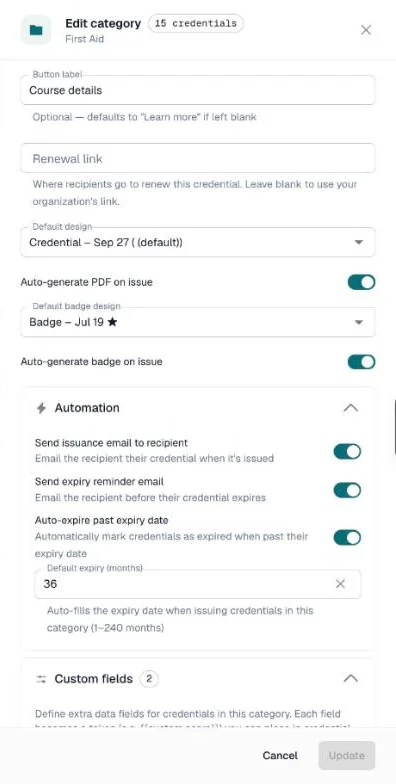
Switch 1: Send issuance email to recipient
What it does: When a new credential is created in this category and the recipient has an email address, CertLister sends them an email with their credential details.
Email the recipient receives:
- Subject:
Your "[Credential Title]" is ready - Content: Recipient name, credential title, issue date, a link to view and verify the credential
When to turn on:
- Training providers who want recipients to receive their credentials immediately
- Compliance programmes where proof of certification needs to be delivered fast
- Any time you want to avoid manually distributing credentials
When to leave off:
- You send credentials through your own system or LMS
- You create credentials in bulk before recipients are ready to receive them
- The recipient email field is often blank in this category
Switch 2: Send expiry reminder email
What it does: CertLister emails the recipient before their credential expires. When the emails go out — up to five reminders — is set organization-wide in Settings → Notifications (default: one reminder 7 days before). See Part 4.
Email the recipient receives:
- Subject:
Your "[Credential Title]" expires in N days - Content: Recipient name, credential title, expiry date, a link to the verify page
When to turn on:
- Safety or compliance credentials where renewals are mandatory (CPR, food safety, OSHA)
- Professional licenses that must be renewed to remain valid
- Anywhere that an expired credential has real consequences for the recipient
When to leave off:
- Credentials that don't have an expiry date set (the reminder only fires when an expiry date exists)
- You manage renewal reminders through another system
- Recipients do not need to take action on expiry
Switch 3: Auto-expire past expiry date
What it does: Every day at 2 AM UTC, CertLister checks all credentials in this category. Any credential whose Expiry Date is in the past and whose status is still Active is automatically flipped to Expired.
This keeps your verification page accurate without manual intervention. When someone verifies a credential that has auto-expired, they see a clear Expired status rather than an incorrect Active status.
When to turn on:
- Almost always — if you set expiry dates, you almost certainly want them enforced automatically
- Any category where expired credentials must not appear as valid
When to leave off:
- You manage expiry status manually and do not want automatic changes
- Credentials in this category regularly run over their nominal expiry date (e.g., grace periods managed externally)
Available on all plans. No plan gate.
Step 3: Save
Click Update (or Create category for a new one) to save the automation settings.
Important: These settings apply to credentials created from this point forward. Credentials that already exist are not retroactively changed, except for auto-expiry — the daily job processes all credentials in the category regardless of when they were created.
Part 2: Sending Emails Manually
Automated issuance emails fire at the moment of credential creation. But sometimes you need to send (or re-send) an email after the fact — for example, when a recipient missed the original email, when you created credentials in bulk before they were ready to be distributed, or when you want to send existing credentials to new email addresses.
Send Email for a Single Credential
- Go to Credentials in the left navigation
- Find the credential row in the table
- Open the row's ⋯ menu and click Send email — it says Resend email if the credential was emailed before
- The Send issuance emails dialog opens. Tick an attachment option if you want one, then click Send emails
The recipient receives the same email as the automated issuance email.
Note: The credential needs a
Recipient Email. If the field is blank, add the email with the pencil icon first.
Send Emails in Bulk
- Select the credentials you want to email using the row checkboxes
- The bulk bar appears — click Send emails
- The Send issuance emails dialog shows how many recipients will receive the email, and how many will be skipped because they have no email address
- Tick Attach PDF credential to email or Attach card PDF to email if you want the files attached
- Click Send emails
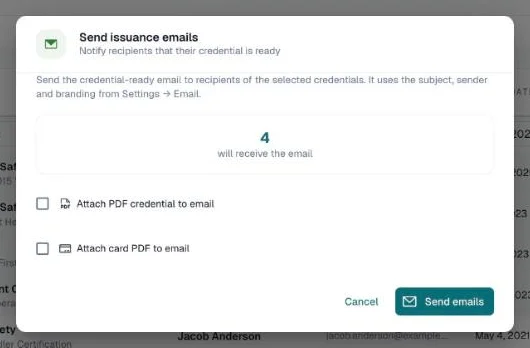
You can send to up to 500 credentials at a time. Large batches are sent in the background — you can leave the page and follow progress from the top bar.
Attach the PDF Credential to the Email
Every email contains a link to the verification page where the recipient can view and download their PDF — unless the credential carries a recipient photo and its category has not turned on photo publishing, in which case the page does not offer the PDF, and the recipient gets it from the attachment or from your recipient portal, if you have turned it on. On every plan, you can attach the PDF directly to the email.
How to enable it:
In both the single-credential and bulk send dialogs, check "Attach PDF credential to email" before confirming.
What happens:
- CertLister fetches the credential's PDF from cloud storage and attaches it as a
.pdffile to the outgoing email - The verification link is still included in the email body — the attachment is in addition to it, not a replacement
- If a selected credential has no generated PDF yet, it is sent without an attachment (the email is still delivered)
When to use it:
- Recipients who prefer to save the PDF directly from their email client rather than downloading from the verify page
- Credentials that carry a recipient photo in a category that has not turned on photo publishing, whose verify page does not offer the PDF
- Organizations that need the PDF in the recipient's inbox as a formal record
- Situations where recipients may not have reliable access to the public verify URL (e.g., offline environments)
When the link-only approach is better:
- Large batches — attaching PDFs increases email size and sending time
- When you want recipients to always access the live, canonical verification record (the verify page reflects the current status; a PDF attachment is a snapshot)
- When some credentials do not yet have a PDF generated
Part 3: Email Settings When You Issue a Credential
The category decides the issuance email. The drawer shows what will happen, and lets you change only the expiry reminder.
Issuance email
When you pick a category in the New credential drawer, a line under the recipients says what the category will do — for example: "1 recipient will be emailed when issued. Set in this category's settings." There is no per-credential switch for this email. To change it, edit the category and turn Send issuance email to recipient on or off.
Note: The issuance email only goes out when a credential is issued. Editing an existing credential does not send it.
Expiry reminder
Once the credential has a recipient email and an expiry date, the drawer shows a Send expiry reminder email checkbox. It starts ticked or unticked to match the category's Send expiry reminder email setting. Change it to make an exception for this credential.
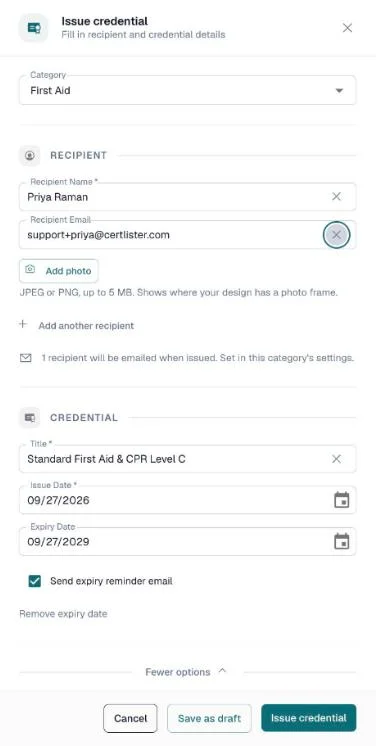
Use cases for unticking it:
- The recipient manages their own renewal and does not want automated emails
- The credential is a one-off that will not be renewed
Part 4: Set When Expiry Reminders Are Sent (Organization Setting)
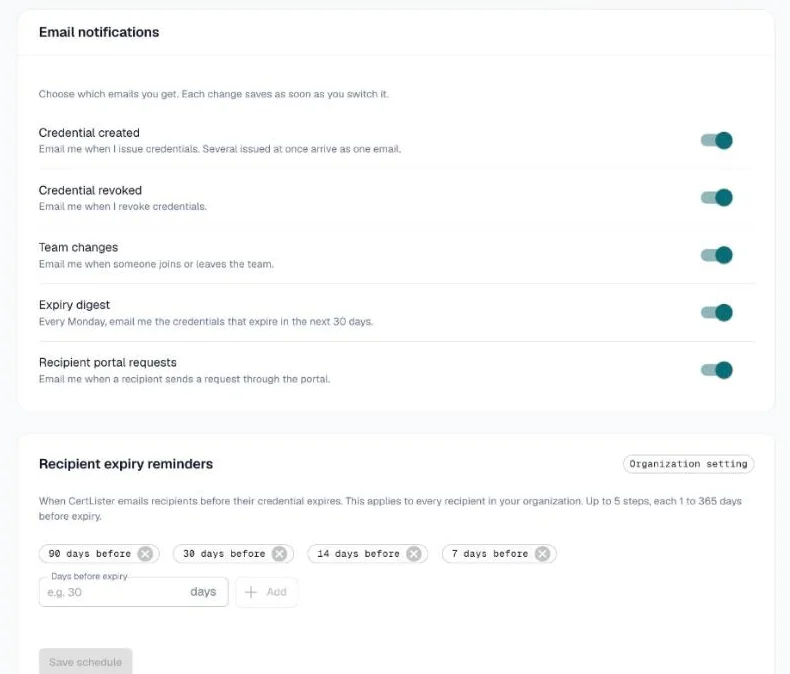
How many days before expiry the reminders go out is one organization-level schedule. It applies to all credentials across all categories.
Default: one reminder, 7 days before expiry
Limits: up to 5 reminders, each 1–365 days before expiry
How to Change It
- Go to Settings → click the Notifications tab
- Find the Recipient expiry reminders section
- Type a number in Days before expiry and click Add — repeat for up to 5 reminders. Remove a step with the × on its chip.
- Click Save schedule (Admin only)
Example: A schedule of 60 and 7 emails recipients 60 days before their credential expires, and again 7 days before.
Part 5: Weekly Admin Expiry Digest
In addition to the automated recipient emails, CertLister sends a weekly summary to organization admins and managers showing all credentials expiring in the next 30 days.
Email sent every Monday at 9 AM UTC.
Subject: N credentials expiring soon — [Your Organization]
Content: A table of credentials expiring within 30 days — credential number, recipient name, credential title, and expiry date.
Enabling the Weekly Digest
- Go to Settings → Notifications tab
- Find the Expiry digest toggle
- Turn it on or off — each team member controls their own preference, and the change saves at once
The weekly digest is independent of the per-credential expiry reminders. Both can be on at the same time: recipients get an individual reminder email, and admins get a Monday summary.
When Do the Automated Jobs Run?
| Job | Schedule | What it does |
|---|---|---|
| Auto-expiry + expiry reminders | Daily at 2 AM UTC | Flips overdue credentials to Expired; sends a reminder email for each step in your reminder schedule that falls on that day |
| Weekly admin digest | Every Monday at 9 AM UTC | Sends a summary of all credentials expiring in the next 30 days to admins/managers with digest enabled |
Important for expiry reminders: Each reminder fires on the day that is exactly that many days before the expiry date. For example, with the default 7-day schedule, a credential expiring on March 10 gets its reminder on March 3 (the morning job on March 3 sends it). Each step in the schedule sends one email; a step whose day has already passed is not sent later.
Common Setup Scenarios
Scenario 1: Training provider — immediate delivery
You run CPR training sessions. Participants should receive their credentials right away.
Category settings:
- Send issuance email: On
- Send expiry reminder: On
- Auto-expire: On
Org setting:
- Recipient expiry reminders: 30 and 7 days (a month's notice, then a last reminder)
Scenario 2: Compliance tracking — no recipient emails
You manage compliance credentials internally. Recipients are employees who should not receive individual emails.
Category settings:
- Send issuance email: Off
- Send expiry reminder: Off
- Auto-expire: On
Weekly admin digest: On (so HR is alerted every Monday about upcoming renewals)
Scenario 3: One-off exception
Your category sends expiry reminders, but one recipient manages their own renewal and asks not to get them.
- Open New credential and fill in that person's details, including the expiry date
- Untick Send expiry reminder email
- Issue the credential — this credential gets no reminders; others in the category still do
Troubleshooting
No email received after creating a credential
Check in order:
- Plan — email delivery is available on every plan.
- Category setting — open the category drawer. Is Send issuance email to recipient turned on?
- Recipient email — open the credential. Is the
Recipient Emailfield filled in and correctly formatted? - Timing — the email is sent at creation time only. Editing an existing credential does not re-trigger the email. To send it again, see Part 2.
- Spam folder — ask the recipient to check spam/junk.
Expiry reminder email not received
Check in order:
- Plan — expiry reminders are available on every plan.
- Category setting — is Send expiry reminder email turned on?
- Expiry date — the credential must have an expiry date set. Open the credential and confirm.
- Recipient email — the credential must have a recipient email.
- Timing — each reminder fires on the morning that is exactly that many days before the expiry date. If that day already passed, that reminder is not sent later.
- Schedule — go to Settings → Notifications → Recipient expiry reminders and confirm the days are what you expect.
- Credential choice — was Send expiry reminder email unticked when the credential was issued?
Credential not auto-expiring
Check:
- Is Auto-expire past expiry date turned on for the category?
- Does the credential have an expiry date set?
- Has 2 AM UTC passed since the expiry date? The job runs once per day — a credential that expired yesterday will be updated during tonight's run.
- Was the credential already manually set to Expired or Revoked? The job only processes Active credentials.
Weekly digest not arriving
Check:
- Plan — the digest is available on every plan.
- Preference — go to Settings → Notifications and confirm Expiry digest is turned on for your user account.
- Role — only Admins and Managers receive the digest. User role does not receive it.
- No expiring credentials — the digest is only sent when there are credentials expiring in the next 30 days. If nothing is expiring, no email is sent that week.
- Timing — the digest is sent every Monday at 9 AM UTC.
Frequently Asked Questions
Q: Can I send issuance emails to recipients who don't have an email address on file?
A: No. An email address must be saved on the credential. If the Recipient Email field is blank, no email is sent even if the category has issuance email turned on.
Q: How many expiry reminder emails will a recipient receive?
A: One per step in your reminder schedule — by default one, 7 days before expiry. Add up to 5 steps under Settings → Notifications → Recipient expiry reminders (for example 30 and 7 days). The schedule applies to all credentials.
Q: What happens if I change the reminder schedule mid-cycle?
A: The new schedule takes effect from the next daily run onward. Reminders that have already fired are not re-sent. Reminders that have not yet fired follow the new schedule.
Q: Does auto-expiry affect the public verification page?
A: Yes. When auto-expiry flips a credential to Expired, the verification page immediately shows it as Expired — not Active. This is the intended behaviour: the verify page reflects the true current status.
Q: Can I undo an auto-expiry?
A: Yes. Open the credential, change the Status field back to Active, and save. Note that if the expiry date is still in the past and auto-expire is still on for the category, the daily job will flip it back to Expired the next night. To prevent this: either extend the expiry date, turn off auto-expire for the category, or set the credential's expiry date to blank.
Q: Does the issuance email include a copy of the PDF?
A: Yes, whenever the credential already has one. The automated issuance email attaches the PDF, alongside the credential details and a link to the public verify page. If the category does not generate a PDF automatically, that email goes out link-only.
Manual sends can attach it too, on every plan — check "Attach PDF credential to email" in the single or bulk send dialog.
See Part 2: Sending Emails Manually for full details.
Q: Are email sends logged anywhere?
A: Yes. Email delivery tracking is available on every plan under Reports → Email Delivery. You can see delivery status, bounces, and a full email log per credential.
Q: Can I customise the email templates?
A: Not currently. Email content is standardised. Custom email templates may be considered for future Pro or enterprise plans.
Q: Does auto-expiry send any notification to the admin?
A: Not directly. The weekly expiry digest on Monday warns admins about credentials about to expire. After they have expired, the digest stops listing them (it only shows upcoming expirations). The admin can filter credentials by status on the Credentials page to see all Expired credentials.