How Long Do You Have to Keep Training Records?

A manufacturing company's HR manager opens a letter from a lawyer three years after the fact. There was an incident on the packaging line in 2023. The question in the letter is narrow: on the day it happened, was the operator trained and current on the equipment he was running?
She knows the answer is yes. She remembers the session — she booked it. What she cannot do is prove it. The operator left in 2024, and when his profile was deactivated his training records went with it. The certificate was a PDF the training provider emailed to a supervisor who has also since left. The one record she can still pull says "expired," which is accurate today and says nothing whatsoever about a Tuesday in March three years ago.
That gap is why "how long do you have to keep training records" is a harder question than it looks. Most people asking it want a number. The honest answer is that the rules which give you a number are mostly about other kinds of records, and the rules written specifically about training records mostly decline to give you one.
Three Bodies of Rules, None of Them Aligned
Training records sit at the intersection of three separate regulatory traditions, and they were written by different bodies for different purposes.
Occupational safety recordkeeping exists so that a regulator can reconstruct exposure and harm. It is concerned with what happened to a person's body over a working life, which is why its retention periods are measured in decades.
Employment law recordkeeping exists so that a discrimination or wage claim can be investigated. It is concerned with the employment decision, so its periods are short — measured from the decision, not from the risk.
Quality and accreditation standards exist so that an auditor can confirm your process works. They care that you can demonstrate competence, and they are largely indifferent to how long you keep the proof, provided you decided in advance and stuck to it.
None of these three sets out to answer "how long do I keep a forklift certification." They answer adjacent questions, and the training record inherits whichever answer someone happened to apply first. That is usually the shortest one.
What Actually Specifies a Period
Four general rules give a real number. It is worth knowing exactly what each one covers, because none of them covers training records as such. (A few training rules do name a period; they come after this.)
Employee medical and exposure records — 30 years. 29 CFR 1910.1020(d) requires that "the medical record for each employee shall be preserved and maintained for at least the duration of employment plus thirty (30) years," and that each employee exposure record "shall be preserved and maintained for at least thirty (30) years." This is the longest retention obligation most employers carry, and it exists because occupational disease can surface decades after the exposure that caused it.
Injury and illness logs — 5 years. 29 CFR 1904.33(a) requires you to save the OSHA 300 Log, the annual summary and the 301 Incident Reports "for five (5) years following the end of the calendar year that these records cover."
Personnel and employment records — 1 year. Under the EEOC's recordkeeping rules, personnel or employment records must be kept for one year from creation, or one year from the date of an involuntary termination. Payroll records under the ADEA run three years. Critically, the one-year clock is not the end of it: once a charge of discrimination is filed, records relating to the issues under investigation must be retained until final disposition of the charge or any lawsuit arising from it.
Everything a client contract says. Not a regulation, but frequently the binding constraint in practice. Prime contractors and healthcare networks routinely require their vendors to retain training documentation for the life of the contract plus a stated number of years, and that clause outranks any statutory floor because you signed it.
The trap in this list is the third item. Training records are the easiest thing in the world to classify as "personnel records," inherit the one-year floor, and dispose of on schedule — a defensible-looking decision that quietly throws away the only evidence that would answer the letter from the lawyer.
What the Training Standards Actually Say
Here is the part that surprises people. Go to the standards that specifically require training, and look for a retention period.
Fall protection. 29 CFR 1926.503(b) requires a written certification record containing "the name or other identity of the employee trained, the date(s) of the training, and the signature of the person who conducted the training or the signature of the employer." On retention, the whole of what it says is this: "The latest training certification shall be maintained." Latest. Singular. Nothing obliges you to keep the one before it.
Respirator fit testing. 29 CFR 1910.134(m)(2)(ii) is more explicit still: fit test records "shall be retained for respirator users until the next fit test is administered." The rule does not merely permit you to discard the previous record — it defines the retention period as ending the moment a newer one exists.
Powered industrial trucks. The forklift standard requires the employer to certify that each operator has been trained and evaluated, and specifies what the certification must contain. It sets no retention period at all.
ISO 9001:2015, clause 7.2(d). Organizations must "retain appropriate documented information as evidence of competence." Appropriate is doing all the work in that sentence, and it is deliberate — the standard leaves the period to you, on the reasoning that you know your risks and it doesn't.
Read together, the pattern is unmistakable and it is not an oversight. These standards regulate whether a person is qualified now. They are competence rules, not evidence-preservation rules. Satisfying every one of them to the letter is entirely compatible with being unable to prove anything about last year.
Where "Three Years" Comes From
A few training rules are the exception, and three years is the period they name most often. You will also meet one sentence everywhere this topic comes up: "All training records must be kept current and be maintained for a minimum of three years." We could not find it in any federal regulation. It reads like a company or state policy, built on rules like these:
- Bloodborne pathogens. 29 CFR 1910.1030(h)(2)(ii): "Training records shall be maintained for 3 years from the date on which the training occurred."
- Hazardous materials transport. 49 CFR 172.704(d) requires a record of current training "inclusive of the preceding three years," kept "for as long as that employee is employed by that employer as a hazmat employee and for 90 days thereafter."
- Select agents and toxins. 42 CFR 73.15(d) requires a record of the training given to each person with access, and 42 CFR 73.17 says all records under that part "must be maintained for 3 years."
One rule counts from the person rather than the training. For asbestos, 29 CFR 1910.1001(m)(4) says "The employer shall maintain all employee training records for one (1) year beyond the last date of employment of that employee," and the construction version, 29 CFR 1926.1101, says the same.
That answers the two questions people ask most:
- For current employees, the hazmat rule is the clearest model: keep the last three years of training for as long as the person works for you.
- For former employees, the clocks keep running after someone leaves: three years from the training date for bloodborne pathogens, 90 days after the job ends for hazmat, one year after employment ends for asbestos. Deleting a leaver's records on their last day breaks all three.
Three years is the floor for those programs, not a period that fits every record. The rest of this guide explains why the period that protects you is usually longer.
Currency and History Are Different Questions
This is the distinction the whole subject turns on.
"Is this person qualified today?" is an operational question. You need it answered constantly, in seconds, at a gate or before a shift assignment, and the answer must be current to be useful. Everything about a good tracking system is optimized for it.
"Was this person qualified on 14 March 2023?" is an evidentiary question. You need it answered rarely, slowly is fine, and the answer must be unchanged to be useful. It is worth very little unless the record was written at the time and has not been touched since.
Systems built well for the first question destroy the answer to the second, in three ordinary ways.
Status gets overwritten in place. One field holds "valid" or "expired," and it flips on the expiry date. The field is always correct and the history is gone — you can no longer distinguish a certification that expired last week from one that expired in 2019, or show that on a given date it read valid.
Renewal replaces instead of appending. Someone recertifies, and the new dates are written over the old row because the old ones are obsolete. They are obsolete operationally. They are the entire record evidentially, and with them goes your ability to show an unbroken chain of qualification across the period in question.
Offboarding deletes. A leaver is removed from the active roster and their records go with them, either by design or because a data-minimization policy caught them. This is the most consequential of the three, because former employees are disproportionately the people you get asked about. Nobody writes a letter about a person who is still on your site and currently certified.
Each of those is a reasonable-looking decision in isolation. Together they guarantee that the only records you can produce are for current employees holding current certifications — precisely the population no one ever asks you to prove anything about.
The Period That Actually Governs You
The regulatory floor is not your retention period. Your exposure window is, and it is almost always longer.
Work out how long a training record could plausibly be needed as evidence, from three directions:
- The claims it would defend. Limitation periods vary by jurisdiction and by type of claim, and several start running from the date a problem is discovered rather than the date it occurred — which can push the window years past the incident itself. Occupational illness is the extreme case, and it is exactly why the medical and exposure record obligation runs thirty years.
- The charges that can freeze the clock. As the EEOC rules make explicit, an active charge suspends normal disposal for anything relating to it. A retention schedule with no legal-hold step in it will delete records that were already required to be kept.
- The contracts and accreditations you have signed. Check the actual clause rather than your memory of it. This is where the longest number often turns out to live.
Take the longest of the three, round up, and — this part matters more than the number — write it down as a schedule and apply it consistently. A documented retention schedule that you follow is itself a defence: disposing of a record under a written, consistently applied policy is a very different conversation from a record that simply is not there. Ad hoc deletion looks like spoliation even when it was carelessness.
One caveat, stated plainly: this is a summary of published rules, not legal advice, and retention obligations differ substantially between jurisdictions. Canadian provincial OHS regimes, EU member-state employment law and sector regulators all set their own periods, sometimes longer than the US federal floors above. Confirm your own with counsel and treat this as a map of the questions to ask.
Setting a Rule You Can Actually Follow
A retention policy fails in practice for the same reasons an expiry policy does — it depends on someone remembering. Five things make it hold on its own.
Capture the dates as data at issuance. The issue date and the expiry date have to live in fields, not as printed text on a PDF. A retention rule is a query over dates; if the dates were never captured as dates, the rule can only be applied by a person opening documents one at a time, which means it will not be applied.
Retain by record type, not by person. The instinct is to organize retention around employment status — active, terminated, purge after X. That is the instinct that deletes the useful records. The obligation attaches to the record and its subject matter, and it is indifferent to whether the person still works for you.
Make offboarding an archive step, never a delete step. Removing someone from the active roster and destroying their history are two different operations, and the second should be difficult to do by accident. Historical records should stay searchable by name long after the person is gone.
Keep the supersession chain. When a certification is renewed, the previous one becomes history rather than garbage. Preserving the chain is what lets you answer a question about any date, not just today, and it costs almost nothing to keep.
Make disposal an event you can point to. When a record is finally destroyed, that should be a logged action under a named policy, with a date. The record of the disposal frequently matters as much as the record it disposed of.
What a System Has to Do to Make This Cheap
None of the above requires anything exotic. It requires that credential records be structured data with dates attached, that history be additive rather than destructive, and that a record survive the departure of the person it describes.
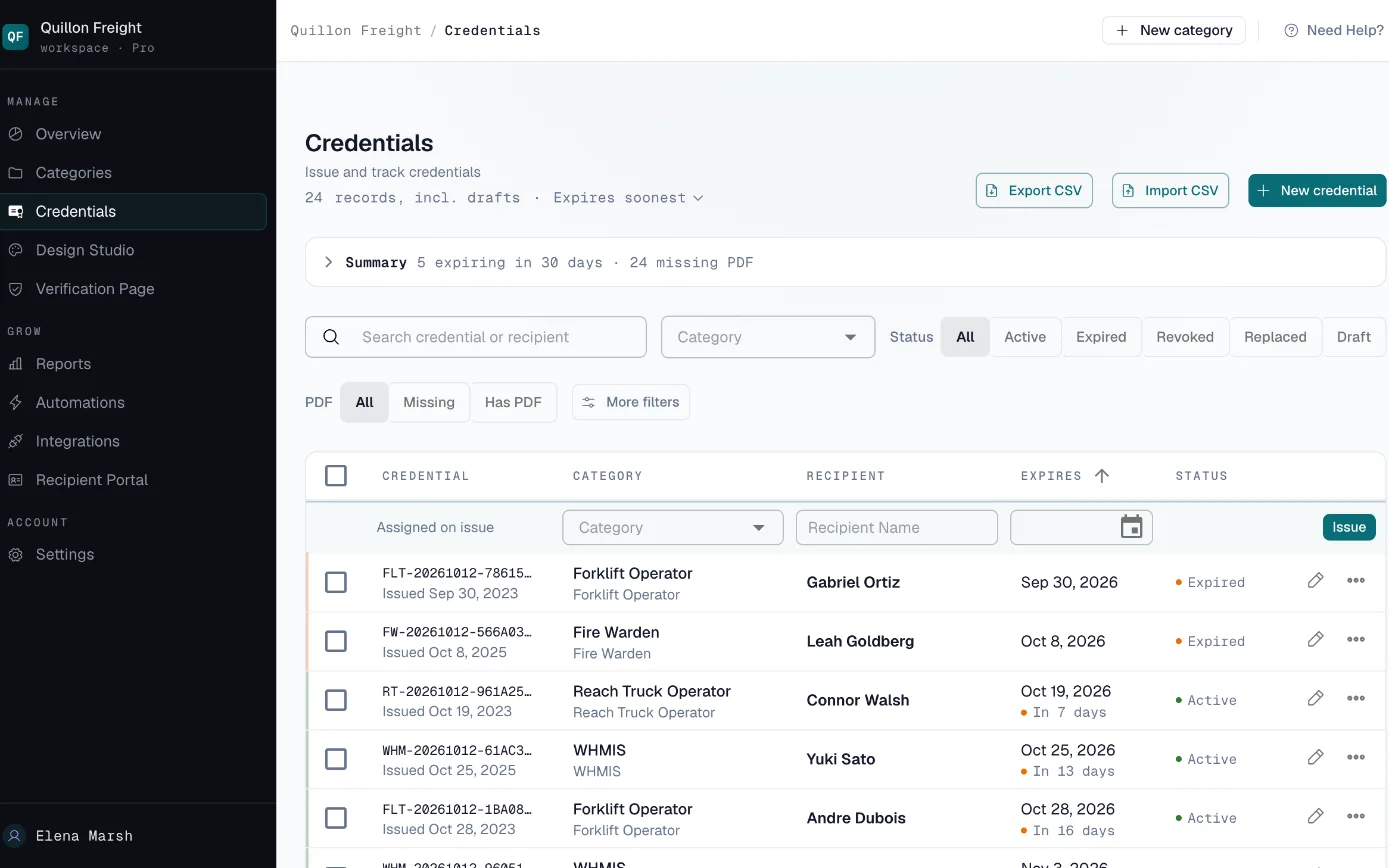
This is where CertLister fits. Every credential carries its issue and expiry dates as structured fields from the moment it is created, so expiry status derives itself for the operational question without overwriting anything. Renewals are issued as their own records rather than edits to the old one, so the chain stays intact. Removing someone from your active roster does not delete their credential history — it stays searchable by name or email, indefinitely, which means the letter that arrives three years later is answered with a search instead of an apology. And because each credential has a permanent verification link, the proof you produce is checkable by the person asking rather than something they have to take your word for.
Retention stops being a project when the records were built to survive in the first place. Our guide to choosing a training records management system covers what else to check before you commit to one.
The Short Version
Four questions. If a letter arrived tomorrow about an incident three years ago, could you answer them?
- Can you produce the training record of someone who left the company two years ago? If offboarding deletes, or archives somewhere no one can search, the answer is no — and this is the population you will actually be asked about.
- Can you show what a credential's status was on a specific past date, rather than only what it is now? A single overwritten status field cannot do this.
- Do you have a written retention schedule, with a legal-hold step, that you could hand to an auditor? The absence of one turns every deleted record into a question about your intent.
- Did you set the period from your exposure window, or from the shortest rule someone found? One year, inherited from the personnel-records floor, is the most common answer and the least defensible.
Getting this right is mostly a matter of not throwing things away, which sounds trivial until you notice how many ordinary system behaviours are designed to do exactly that. For the operational half of the problem — knowing what is current, today, before someone else finds out it isn't — compliance certificate tracking at scale and preparing for a training compliance audit cover the ground next to this one.
CertLister is a digital credential platform built for organizations that have to prove what they trained, and when. Issue credentials with structured issue and expiry dates, keep the full history after someone leaves, and give every record a permanent verification link. Start free →
Move your certification spreadsheet into CertLister
Import your records from a CSV file, set expiry dates, and see who needs to renew next.
Free plan: 10 credentials a month. No credit card.