Safety Certification Expiry Tracking: Catching a Lapse Before It Reaches the Job Site
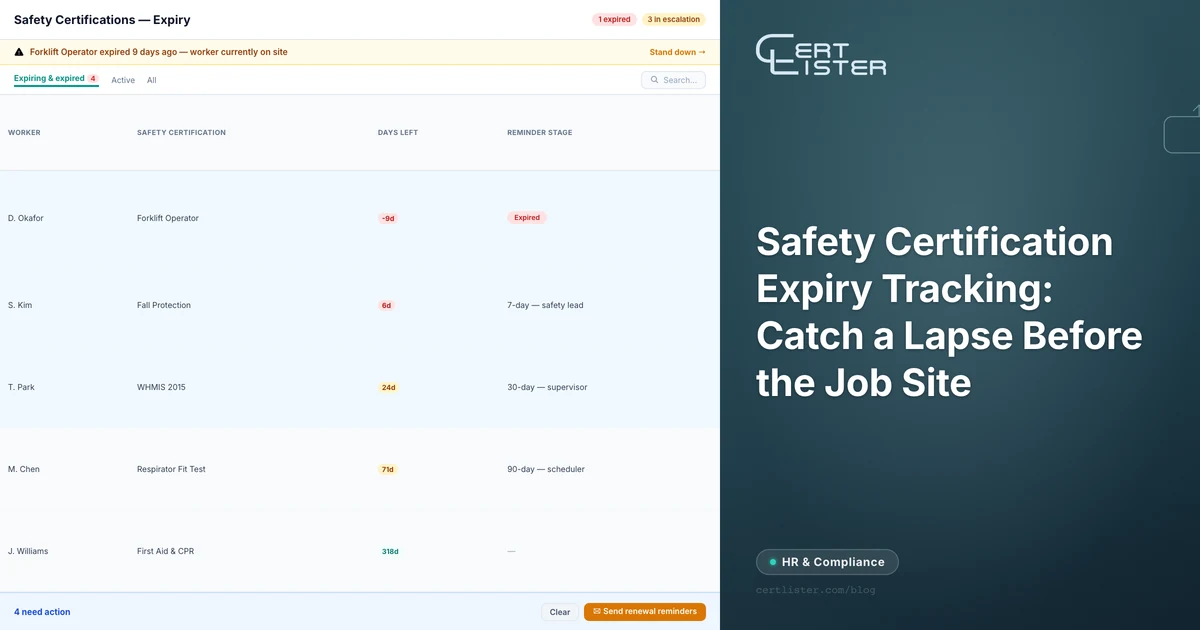
A contractor's safety coordinator gets a call from the client's site auditor on a Thursday afternoon. One of their operators has been running a lift truck on site all week. His powered industrial truck evaluation expired nine days ago.
Nobody hid anything. The operator didn't know — his card was in his wallet and the date on it was small. His supervisor didn't know, because the supervisor's copy of the training roster was a spreadsheet exported eleven months earlier. The safety coordinator didn't know, because the training provider that ran the course keeps its own records and had no reason to call. Four people had a piece of the answer and none of them had the whole thing.
That's the shape of almost every safety certification lapse. It isn't negligence and it rarely involves anyone making a decision. It's a date that passed while the information about it was scattered across a wallet, a spreadsheet, and somebody else's database — and the first person to assemble those pieces was the auditor.
Why Safety Certifications Lapse Differently
Most business records fail in ways you notice. An unpaid invoice generates a reminder. A missed deadline has someone waiting on the other end. A safety certification is different: it lapses in silence, and everything keeps working exactly as it did the day before.
Part of the reason is that the record lives with the person rather than the organization — a wallet card, a wrinkled certificate, a PDF in an email account from two employers ago. The employer usually holds a copy, but a copy is a snapshot: accurate the day it was filed and never updated again. Meanwhile the authoritative record sits with the training provider who ran the course. They know the expiry date. They have no obligation to remind anyone, and often no current contact at the employer to remind.
Then there's the timing. Forklift operator evaluations run on one clock, respirator fit testing on an annual one, first aid and CPR typically on a two-year cycle, and site orientations on whatever the client decides. Nothing lines up. There is no week in the year when everything comes due at once and somebody notices — they come due in ones and twos, continuously, forever.
So the failure has no warning signal built into it. If you want one, you have to build it.
The Four Places a Lapse Hides
When a certification expires without anyone catching it, the failure is almost always one of four — and they're worth separating, because they have different fixes.
1. There is no single register — there are several.
Safety training records tend to accumulate wherever they were created. A spreadsheet the safety coordinator maintains. A folder of PDFs from the training provider. The HR system, which has some of them because they were part of onboarding. A binder in the site trailer. None of these is wrong, and none of them is complete. Ask "how many people on this site have current fall protection training" and the honest answer is that somebody would need to reconcile four sources to find out.
2. The expiry date was never captured as a date.
This one is subtle and extremely common. The certificate says "valid until June 2026" in printed text on a PDF. That's a date a human can read and a system cannot act on. If the expiry was never entered into a field that something queries, then no amount of software downstream can warn you — the information exists, but only in a form that requires a person to go looking. Records that get filed without their expiry date captured are records that can only ever be audited manually.
3. The reminder went to someone who couldn't act on it.
Plenty of organizations do send expiry reminders and still get caught. Usually because the reminder went to a shared safety@ inbox nobody owns, or to the worker — who can't book himself onto a course that needs a purchase order — or to a manager who left in March. A notification that doesn't reach someone with both the authority and the budget to schedule a renewal isn't a control. It's a log entry.
4. There is no proof available at the point it matters.
Even when the record is current and correct, it frequently can't be produced at the gate. A supervisor deciding whether to let someone start a task, or a client auditor doing a spot check, needs an answer in seconds. If confirming a certification means emailing the office and waiting, the practical effect during that window is the same as not having the record at all.
What Expiry Tracking Has to Actually Do
"Track certification expiry" sounds like a single feature. Operationally it's several separate jobs, and skipping any one of them reopens one of the gaps above.
One register, and it's the one people actually use. Not the most complete one — the one that gets updated. A partial register everyone works from beats an exhaustive one that three people know exists. This usually means consolidating into a single system and then deliberately retiring the others, because a spreadsheet that survives alongside the new system will keep being edited.
Expiry captured at issuance, as structured data. The moment a credential is created is the only moment when someone reliably knows both the issue date and the validity period. Capture it then, in a field, and every downstream capability becomes possible. Capture it later and you're transcribing PDFs. It is the single cheapest habit in the whole process, and at the moment you do it, it costs nothing.
Status that derives itself. A record shouldn't say "valid" because someone typed "valid" into it. It should say valid because today's date is before the expiry date — and flip to expired on its own, without human intervention, the moment it isn't. Any status that depends on somebody remembering to update it will eventually be wrong, and it will be wrong in the direction that looks fine.
An answer available to whoever needs one. Including people outside your organization — the client's auditor, the site supervisor from another company, the HR team at the firm that hired your graduate. If the only path to an answer runs through your office during business hours, you've built a bottleneck that will fail precisely when it's under load.
Our general expiry best practices post covers the broader version of this across all credential types. What follows is specific to safety, where the consequence of getting it wrong is regulatory rather than administrative.
Building an Escalation Ladder That Ends in Someone's Hands
A single reminder at thirty days is the most common setup and it's not enough — not because thirty days is the wrong number, but because one notification has one chance to reach the right person. Ladders work better because each rung assumes the previous one failed.
A shape that holds up in practice:
- 90 days — the scheduler. Goes to whoever books training, not to the worker. Ninety days is roughly the horizon at which a course seat can still be reserved without paying a rush premium, and at which a whole cohort can be batched into one session instead of four individual bookings.
- 30 days — the worker and their direct supervisor, together. The worker needs to know it's coming. The supervisor needs to know because they're the one who'll have to cover the shift while the worker is in class.
- 7 days — the safety lead, flagged as at-risk. By this point the assumption is that something went wrong with the booking. This rung exists to surface the exception, not to remind anyone of the date.
- On expiry — everyone above, plus a status change that's visible without opening an email. The record itself must now read as expired everywhere it appears.
Two details separate a ladder that works from one that generates noise. Each rung should go to someone who can do something at that stage — the scheduler at 90 days, the supervisor at 30, the safety lead at 7. And the ladder should stop when the renewal is recorded, so that a person who has already handled it doesn't keep getting escalated at. Automation is what makes this maintainable; building the same ladder out of calendar invites works for a dozen people and collapses somewhere around fifty. In CertLister, workflow automations can fire at each rung to email the holder and notify your admins, or pass the event by webhook to a system that knows each worker's supervisor.
The Gate Problem
Tracking solves the office side. It doesn't solve the moment when a supervisor is standing in front of someone at seven in the morning deciding whether they can start.
That decision gets made either way. The only question is whether it's made on evidence or on memory — and the failure mode is predictable, because the pressure at that moment is always toward yes. The crew is waiting, the equipment is booked, and the alternative is a delay someone has to explain.
What closes that gap is a credential a supervisor can check on a phone, from the gate, without an account. A public verification page turns the question into a scan or a search that returns a live status — current or not, as of right now, not as of whenever the roster was printed. It also changes the conversation with clients: when a site auditor can verify your people themselves in ten seconds, verification stops being a request that lands on your safety coordinator's desk and becomes something that just resolves.
This is where CertLister fits for safety and healthcare organizations. Every credential carries its expiry as structured data from the moment it's issued, its verification page reads expired as soon as the expiry date has passed, reminder emails reach the holder on the schedule you set while automations can bring your admins in, and each credential has a permanent verification link a supervisor or auditor can check without going through you. The register, the ladder and the gate answer come from the same record rather than three systems that have to agree.
When One Has Already Lapsed
Assume this will happen while you're building the system, because it will. There's a version of the response that contains the problem and a version that compounds it.
Stand the person down from the task the certification covers, immediately and in writing. Not the job — the specific task. This is the step people skip because it feels disproportionate, and it's the one that matters most if anything goes wrong afterward. A documented stand-down is the difference between a lapse and a knowing violation.
Find out how far it spread before you fix the one you found. A lapse discovered by an auditor is rarely singular — it's the one that happened to surface. Filter the whole register for anything expired or expiring inside sixty days and deal with the set, because the second lapse found by the same auditor is a much worse conversation than the first.
Record the gap honestly rather than backdating the renewal. When the new certification is issued, its dates are its own. Overwriting history to make the timeline look continuous turns an administrative failure into a records-integrity problem, and auditors are considerably better at spotting that than at spotting the original lapse.
Fix the rung that failed, not the person. Trace which notification didn't land and why. If the 30-day reminder went to a departed manager, the fix is the routing. If no reminder existed because the expiry was never captured as a date, the fix is at issuance. Treating a lapse as an individual failure guarantees the next one, because the mechanism that produced it is still in place. Our guide to preparing for a compliance audit covers what this looks like when someone is actively asking.
The Short Version
If a client's auditor arrived tomorrow morning, could you answer these without calling anyone?
- Can you produce, in one place, every safety certification your people hold — with its expiry date as a date, not as text on a PDF?
- Does a certification's status change on its own the day it expires, or does it change when somebody notices?
- Does the expiry reminder reach a person with the authority and budget to book the renewal — and does it escalate if they don't?
- Could a supervisor at the gate, or your client's auditor, confirm someone is current in under a minute without going through your office?
Any "not really" in that list is where the next lapse is already forming. It isn't visible yet, which is exactly the property that makes this category worth building a control for. For the wider compliance picture beyond safety specifically, compliance certificate tracking at scale covers the same problem across every certification type an organization has to stand behind.
CertLister is a digital credential platform built for organizations that can't afford a lapsed certification. Track expiry automatically, escalate renewal reminders to the people who can act on them, and give every credential a permanent verification link a supervisor or auditor can check in seconds. Start free →
See it in action. No card, no commitment
Join schools, companies, and training centers using CertLister. Free plan available, no credit card required.
Get Started Free