What Should a Training Certificate Include?
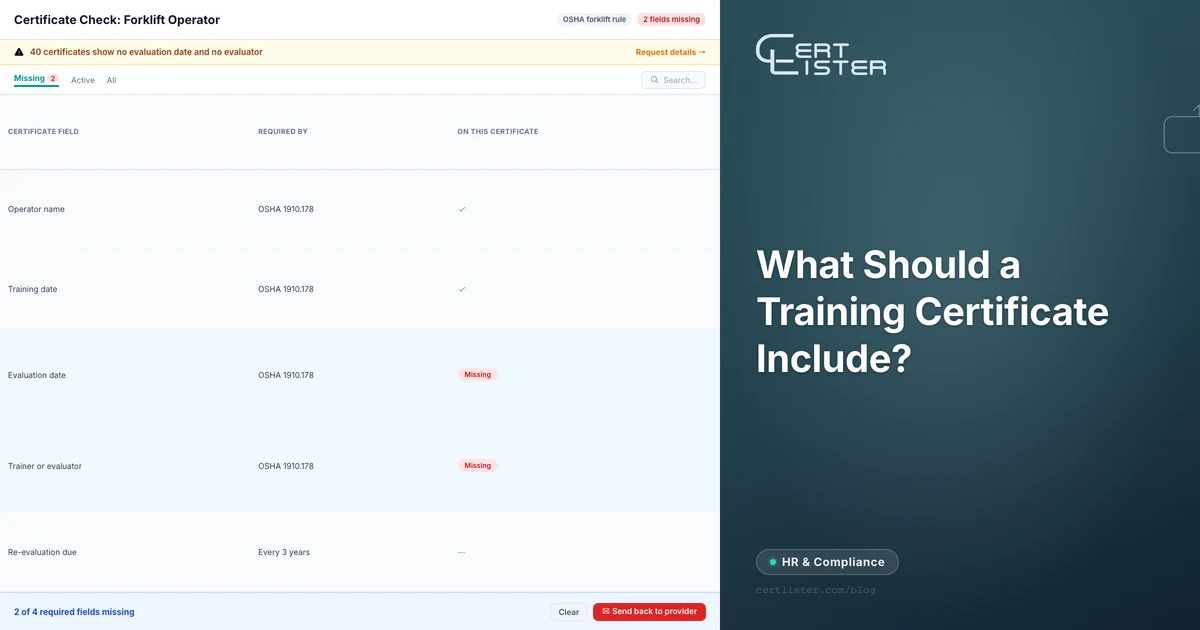
A training provider runs forklift courses for a regional logistics company. Classroom in the morning, a driving evaluation in the yard after lunch. Forty operators went through last year, and each one left with a tidy certificate: their name, "Forklift Operator Certification," the provider's logo and the course date.
During an internal audit, the client's safety manager pulls those certificates into the compliance file and emails the provider the same afternoon. OSHA's forklift standard says an operator's certification must include the date of the training, the date of the evaluation, and the identity of whoever did the training or evaluation. The certificates show one date and no names. Every operator was evaluated, but nothing on paper says when or by whom, and the only people who know are at the training provider.
The provider didn't cut corners on the training. They designed a certificate that looked complete, and nothing on the page said otherwise. Most certificate problems start that way, which is why "what should a training certificate include" needs a more exact answer than a template.
Where the Rules Agree
Several regulations spell out what a training certificate or training record has to show. Read side by side, they agree on less than you'd expect.
The ones that list fields all start with the person's name and a date. Most also want to know who gave the training. Beyond that, each rule adds requirements of its own, and the lists barely overlap. A certificate designed around one rule can fail the next, and a provider whose clients include warehouses, construction firms and trucking fleets is designing for several at once.
What Each Rule Adds
| Rule | Who it covers | Required beyond name and date |
|---|---|---|
| OSHA 29 CFR 1910.178(l)(6) | Forklift operators | A separate evaluation date; the identity of the trainer or evaluator |
| OSHA 29 CFR 1926.503(b) | Construction workers exposed to fall hazards | The signature of the trainer or the employer |
| DOT 49 CFR 172.704(d) | Hazmat employees | The trainer's name and address; the training materials used; a statement that the employee was trained and tested |
| EPA 40 CFR 745.225(c)(8) | Lead-based paint courses | A unique ID number and address for the individual; the course name; the provider's address and phone; the language taught; a photo and expiry date for renovators |
| MSHA 30 CFR 48.9 | Miners | Recording on MSHA Form 5000-23; a copy for the miner |
| Ontario working at heights | Construction workers who use fall protection | The approved provider's name and the program name |
The forklift standard is the one from the opening. The employer must certify that each operator "has been trained and evaluated," and 29 CFR 1910.178(l)(6) sets out what that certification contains: "the name of the operator, the date of the training, the date of the evaluation, and the identity of the person(s) performing the training or evaluation." The same standard requires a new evaluation "at least once every three years," a date most forklift certificates leave the reader to work out.
Fall protection in construction asks for something different. Under 29 CFR 1926.503(b), the written certification record "shall contain the name or other identity of the employee trained, the date(s) of the training, and the signature of the person who conducted the training or the signature of the employer." There is no evaluation date. There is a signature, which the forklift rule never mentions.
The DOT's hazmat rule turns to the trainer and the course material. 49 CFR 172.704(d) requires the employee's name and "the most recent training completion date," plus "a description, copy, or the location of the training materials used," "the name and address of the person providing the training," and a certification that the employee "has been trained and tested." Hazmat training has to be repeated "at least once every three years."
The EPA's lead-based paint rule is the most detailed of the group, because it regulates training providers directly instead of employers. Under 40 CFR 745.225, accredited programs "shall issue unique course completion certificates," and each must carry "the name, a unique identification number, and address of the individual," the course name, the completion dates, the program's "name, address, and telephone number," and "the language in which the course was taught." Renovator certificates also need a photograph and an expiration date. For courses delivered online, the same section adds a requirement most certificate designers never consider: "The electronic certificate must not be susceptible to easy editing."
MSHA doesn't leave the format to anyone. Under 30 CFR 48.9, the mine operator records and certifies training "on MSHA form 5000-23," and "a copy of the training certificate shall be given to the miner at the completion of the training." It is also the only rule in this group that states the penalty in the same place: "False certification that training was given shall be punishable."
Ontario's working at heights program gives employers a choice. They can keep a copy of the worker's proof of completion, or a record with the worker's name, the approved training provider's name, the program's name and the completion date. The training is valid for three years.
Line those up and the shared ground is thin. A name, a date, and usually someone accountable for the training.
Certificate or Record: Who Owes What
Five of these six rules put the obligation on the employer, not on whoever ran the course. The forklift, fall protection, hazmat, mining and Ontario rules all describe something the employer or mine operator creates and keeps. The provider's certificate is the evidence that record gets built from. Only the EPA regulates the provider's certificate directly.
Fall protection also covers the worker who arrives already trained by a previous employer. In that case the record "shall indicate the date the employer determined the prior training was adequate rather than the date of actual training." Someone has to read the old certificate and decide whether it's enough. When a field is missing, they can chase the issuer for it, fill the gap from memory, or train the person again. None of those is free, and the second is how records end up wrong.
For a training provider, this is the practical reason to care about fields. Your certificate becomes an input to your client's compliance record, often while they are deciding whether to keep sending people to you. Our piece on what HR teams check before approving a training provider covers the rest of that decision.
Fields the Rules Mostly Skip
A few of the most useful fields appear in one rule or none. They are still the ones that decide whether a certificate gets accepted without a phone call.
A unique certificate number is the first. Only the EPA requires unique certificates and an ID number for the individual, but a number is what lets someone ask the issuer about one specific certificate instead of "a J. Smith who took a course in March."
An expiry or re-evaluation date is the second. Forklift evaluations, hazmat training and Ontario's working at heights training all run on three-year cycles, yet none of those three rules requires the date to appear on the certificate. The EPA does, for renovators. Without it, whoever reads the certificate has to know the cycle and do the arithmetic.
Contact details for the issuer come third. The DOT wants the trainer's address and the EPA wants the program's phone number. Everyone else just wants to know who to call when something looks off.
The last is a way to check that the certificate is real. A PDF can be edited in a minute, and the EPA's line about electronic certificates is the only place in these rules that deals with it. Anyone who accepts certificates from outside their organization deals with it anyway, which is why a certificate number is only half the answer. Someone also has to be able to look it up. How training providers can fight certificate fraud goes further into that side.
Why Certificates Get Sent Back
Put the rules next to what a careful reader checks, and the common failures are easy to predict:
- The certificate has the classroom date but not the practical evaluation, so a forklift employer can't use it as it stands.
- It carries the provider's logo but names no trainer, which falls short of both the forklift rule and the hazmat rule.
- The course title is a brand name, like "Safety Essentials," that doesn't say which requirement the course meets.
- It has no expiry date, so someone who doesn't know the cycle treats a four-year-old certificate as current.
- The name on it doesn't match the worker's ID, and there's no number to settle which person it belongs to.
- It's an editable file, with nothing that ties it back to the issuer's own records.
A Field List That Covers the Rules
If your certificates go to people who work under more than one of these rules, design for all of them at once. A field that one course doesn't need can stay blank. A field the certificate has no place for can't be added later without reissuing everything.
- The person's full name, as it appears on their ID
- A unique certificate number
- The course or program name, specific enough to show which requirement it meets
- The date or dates of training
- The date of any practical evaluation, as its own field
- The trainer's or evaluator's name, and the provider's name, address and phone number
- A signature from the trainer or the employer
- An expiry or re-evaluation date
- The language of instruction, where a rule asks for it
- A link or QR code that opens the issuer's own record of the certificate
Where CertLister Fits
Most of the failures above come from treating the certificate as a picture. The data exists somewhere, usually in a spreadsheet or in someone's memory, and the PDF is a snapshot nobody can query.
In CertLister, each credential stores the recipient's name, the credential title, the issue date, the expiry date and a unique credential number as fields, and the certificate PDF is generated from them. Anything the core record doesn't cover, such as an instructor, an evaluation date or training hours, can be added to a category as a custom attribute on the Pro plan, then placed on the certificate design and shown on the verification page. A QR code on the design opens that verification page, which shows the issuing organization and whether the credential is active, expired, revoked or replaced by a renewal.
The safety manager in the opening would have found the evaluation date and the evaluator's name on the certificate itself, and could have checked both against the provider's record in the time it takes to scan a code.
The Short Version
Before you send out the next batch of certificates, or accept one from outside, check four things:
- Does it show every date the rule asks for? For forklifts, that means the training and the evaluation, separately.
- Does it name the person who gave the training, not just the company?
- Does it say when it stops being valid, so nobody has to know the cycle?
- Could someone who has never heard of the provider confirm it's real without a phone call?
This is a summary of published rules, not legal advice. Requirements vary by state, province and sector, and many regulators not covered here set their own. Check the rules that apply to the people you train or employ.
A certificate that passes those four still has to stay current, and the record has to outlast it. Safety certification expiry tracking covers the first problem, and how long to keep training records covers the second.
CertLister is a digital credential platform for training providers and the organizations that rely on their certificates. Issue credentials with structured names, dates and unique numbers, and give every certificate a verification link anyone can check. Start free →
See it in action. No card, no commitment
Join schools, companies, and training centers using CertLister. Free plan available, no credit card required.
Get Started Free