What HR Teams Actually Check Before Approving a Training Provider
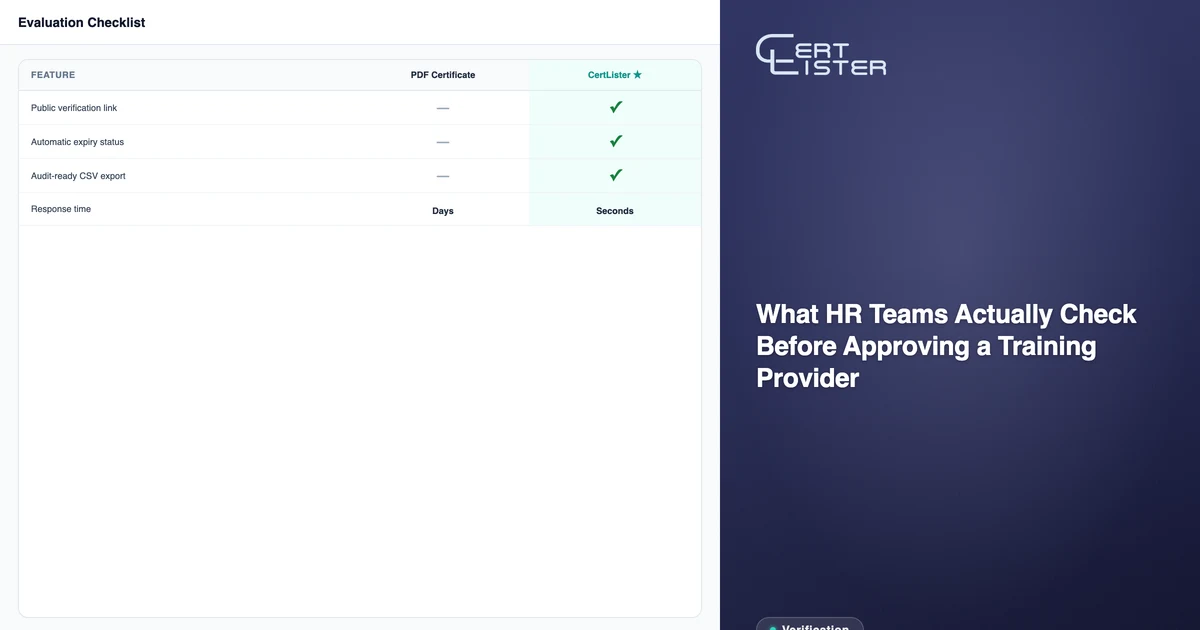
A logistics company's HR department emails a training center: "Before we can send our next class of forty forklift operators through your program, procurement needs you to complete a vendor review." Attached is a short questionnaire. Nothing about curriculum or instructor qualifications — those got a passing glance during the sales call. The questions are about the certifications themselves: how they're verified, what happens when one expires, and how fast someone can get an answer if an auditor asks.
For a training center that's been running the same paper-and-PDF process for years, this is the first time anyone has asked. It doesn't go well — not because the training is bad, but because the paperwork can't answer questions the buyer now needs answered before signing a recurring contract.
This kind of review is becoming routine. Corporate buyers who used to take a training provider's word for it are now under their own compliance pressure — audits, insurance requirements, contractual obligations to their own clients — and that pressure flows downstream to whoever issues the certifications their employees carry. The training center that can answer the questionnaire in five minutes gets the contract. The one that has to "check and get back to you" doesn't.
Why This Bar Keeps Rising
None of this is really about the training provider. It's about what the buyer's own HR and compliance team is on the hook for.
When an auditor asks a company to prove every forklift operator on a job site is currently certified, "we sent them to a good program" isn't an answer — the auditor wants a record: who, what, when, and proof it's still valid. If the company's only documentation is a folder of PDFs a training center emailed eighteen months ago, they can't answer that request quickly, and they can't tell whether any of those certifications have quietly lapsed since.
So the diligence that used to stop at "does this provider have a good reputation" now extends to "can this provider's credentials survive our own audit." A training center that can't answer that question isn't disqualified for being a bad program — it's disqualified for being a documentation liability.
The Four Things a Reviewer Actually Checks
Strip away the specific wording of any procurement questionnaire and it collapses to four questions.
1. Can the credential be verified without calling you?
A PDF with a logo and a signature isn't evidence — anyone with basic design software can produce one that looks identical. What a reviewer wants is a link: enter a name or a credential number, get back a record that either exists or doesn't. If the only way to confirm someone completed a course is to phone the training center during business hours and wait for a callback, that's a fail, regardless of how good the actual training was.
2. What happens when a certification expires?
Most safety and compliance certifications aren't permanent. A reviewer wants to know whether the training center's system tracks that lifecycle or whether expiry is something the employer has to track manually on their own spreadsheet. "We don't really monitor that after issuance" is the answer that ends a lot of vendor conversations early.
3. Can you produce records for an entire cohort, not just one person?
An individual verification link is table stakes. What separates a provider that scales with a corporate client from one that doesn't is whether they can hand over a filtered export — every employee from Company X, their certification status, issue and expiry dates — in minutes instead of days. Reviewers ask this because they know they'll need that exact export themselves the first time their own auditor comes calling.
4. How fast can you respond to a request?
This is less a formal question than an observation the reviewer makes during the process itself. If getting a straight answer to the first three questions takes a week of back-and-forth, that's the response time they should expect for every future request too — including the one that lands during an actual audit, when slow isn't just inconvenient, it's a liability.
What Failing This Review Actually Costs
None of these four gaps show up in the classroom. The training can be excellent and the paperwork can still fail review, because reviewers aren't evaluating instruction — they're evaluating whether they can trust and reuse the credentials their employees will be carrying. Certificate fraud and unverifiable credentials are close cousins of this problem: a provider that can't prove a credential is real and current looks the same to a reviewer as one that's actively being counterfeited, even though the two situations are nothing alike.
The cost isn't just losing one deal. It's staying off the preferred vendor list entirely — the shortlist that corporate buyers default to without running a fresh review every time. Once a company decides a provider's paperwork is a hassle, procurement routes future cohorts elsewhere by default, and the training center never finds out why the volume dried up.
What Passing on the First Try Actually Requires
The fix isn't a better questionnaire response. It's infrastructure that makes the honest answer to all four questions "yes" without anyone scrambling to produce it.
That means every credential gets a permanent, public verification link instead of a static PDF — something a reviewer can click during the call, not something they have to take on faith. It means expiry dates are tracked automatically rather than left to whoever remembers to update a spreadsheet, with workflow automations handling renewal reminders before a certification lapses instead of after someone notices. And it means a filtered, exportable view of every credential issued to a given employer's cohort exists on demand, so "can you send us a compliance report" is a two-minute request instead of a research project.
This is the specific problem CertLister is built to solve for training providers: bulk-issue credentials from a CSV, give every one a verification URL and tracked expiry status, and produce the audit-ready export a corporate buyer's own HR team will eventually need. None of it requires the training center to build anything — it's the default behavior of how credentials are issued.
The Payoff Compounds
Passing one vendor review is worth one contract. Being able to pass every vendor review without extra work is worth something bigger: it's the difference between being evaluated from scratch each time and being the provider corporate buyers route new cohorts to automatically, because the last review went smoothly and nobody wants to repeat that process with someone unproven.
It also quietly kills the recurring cost every training center already knows about — the trickle of emails asking "can you confirm this person completed your program?" months or years after the fact. When verification is a link instead of a request, those emails stop arriving, because the answer was already available the moment someone needed it.
The Five-Minute Version
If a corporate reviewer asked about your program tomorrow, could you answer these without checking with anyone?
- Does every credential have a link a reviewer can click to verify it, with no login and no email required?
- Does a certification's status update automatically the moment it expires — not whenever someone happens to notice?
- Can you export every credential issued to a specific employer's cohort, filtered and dated, in under five minutes?
- If an auditor asked to confirm someone's certification right now, could you answer before the call ends?
If any of those is "not really," that's the gap a reviewer will find first.
CertLister is a digital credential platform built for schools and training centers. Issue branded, verifiable credentials in bulk, track expiry automatically, and hand corporate buyers the audit-ready export they'll ask for eventually. Start free →
See it in action. No card, no commitment
Join schools, companies, and training centers using CertLister. Free plan available, no credit card required.
Get Started Free